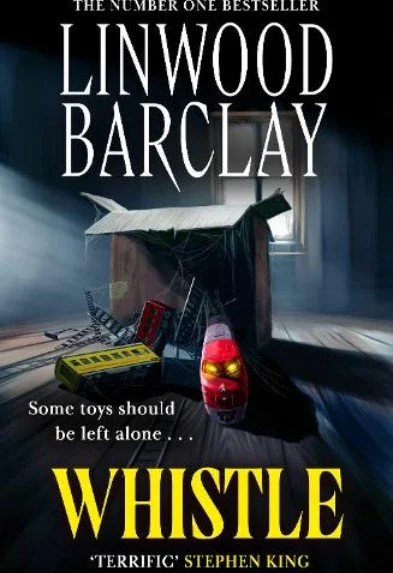
Whistle
You probably don’t need me to actually describe Linwood Barclay’s Whistle. If the charmingly retro cover art and font choices don’t give it away by themselves, the publisher has helpfully included a Stephen King blurb just to make sure there’s no confusion: this is a throwback to vintage horror fiction of the 90s, more specifically Stephen King horror fiction of the 90s, even more specifically the period around the publication date of Needful Things where King’s then-current style had been really solidified.
Yes, there’s a reason I chose Needful Things in particular.
The plot: in the modern day a woman and her young son move into a house in Vermont for the summer, hoping to recover from a series of devastating personal tragedies. When little Charlie finds a toy train set in a shed out in the garden, spooky-wooky events begin to happen. Meanwhile, back in 2001, the police chief of a nearby town deals with a rash of murders, suicides, disappearances and strange accidents, all of which started after a new model train shop appeared on the main street, seemingly overnight.
…So, yes, the plot strand about a diner-loving small-town lawman battling the supernatural proprietor of a funny little shop that jumps from town to town, whose products inspire mayhem and violence, is more than a little bit similar to a certain Stephen King novel from 1991. I don’t think Barclay was trying to pull a fast one here; In the present-day half of the story Annie references Needful Things explicitly, which must be a deliberate tip of the hat. And, you know, I doubt King would have been happy to supply that cover blurb if he felt Barclay had ripped him off. (Although then again the man has endorsed some truly awful garbage over the decades, so who knows).
If you want to look at this as a Stephen King pastiche, then it’s a pastiche that identifies and pares away most of King’s bad habits. The plot zips along at a relentless pace (Linwood Barclay writes thrillers as his day job, and you can tell), point of view characters are kept to the minimum number necessary to convey the plot, we don’t get masses of tumorous backstory for side characters that don’t end up mattering. Charlie, Annie’s son, comes across like a semi-believable facsimile of a human child instead of something constructed by aliens who have heard of the concept of childhood but have never experienced it first-hand. There’s no weird horny sex stuff.
Other than that, this is so King-pilled that you could easily fool someone into thinking it was written by King himself. We’ve got random childhood psychic powers, clownish cartoon villains, liberal politics delivered so obnoxiously that it’s annoying even if you agree with everything the book is saying, lots of Product Names, references to 9/11, all the hits are here.
One area where the book manages to out-King King despite using the exact same tropes is its villain, Edwin Nabler, proprietor of Choo-Choo’s Trains. If this character had been written by Stephen King, he would have been intensely annoying, given that he’s a jolly little man in a train conductor outfit who does evil things for the sake of being evil. A few factors partially stop Nabler from this fate: he has a slightly more interesting metaphysical purpose than most of King’s evil-because-they’re-evil villains (and some intriguing hints at a place in a larger supernatural milieu), he acknowledges that the train conductor outfit is stupid but keeps using it because it’s good for business, and most importantly, he talks and acts like a regular dude instead of a second-rate Batman villain.
The downside to all of this is that Nabler isn’t remotely scary or threatening, and in fact neither is the book as a whole, but then again most of Stephen King’s books aren’t particularly scary, so why should that stand in the way of a King pastiche?
Two factors reduce Whistle to an enjoyable, but ultimately forgettable, read. The first is the prose, which I can only describe as lacking flavour. Locations and environments are described in flatly literal terms, often by simply listing the physical objects contained within them, as in this example where Police Chief Harry visits his favourite diner during a lunch rush:
“At the Lucknow Diner, it was business as usual. But the lack of a table out front had done nothing to hurt their business. The place was packed, even busier than on a usual weekday morning. Inside, Jenny and her staff were run off their feet, showing people to booths, taking orders, wiping down tables the moment customers left so they could quickly seat people waiting in line, refilling mugs of their famous coffee. In the kitchen, the two cooks were furiously cracking eggs, frying bacon, and flipping pancakes.”
An overworked diner in the middle of a surge of customers due to a town holiday is such a rich location to describe, but we don’t get anything of the sweaty atmosphere inside, the hum of annoyance coming from the customers and staff, the way the diner smells and sounds with all that activity going on. Instead it’s just a flat statement of the diner’s condition, here’s a list of what the waitresses are doing, here’s a list of what the cooks are doing. Most locations and scenes in the book are rendered this way: the current point of view character will walk into a place, look around, and the book will assemble a short list of objects contained therein.
The other major problem I had with the book is the way its plot and exposition are delivered, which is to say multiple times over. During Nabler’s POV sections we get basically all the details we need about his nature and operation, then Harry figures out most of the same information before getting handed the rest during an exposition showdown with Nabler, then in the present day Annie goes to confront Nabler at his shop and gets the same information all over again. And keep in mind, the reader will almost certainly have put most of this together from context clues before Nabler, or Harry, or Annie ever explicitly spell it out on the page, so it’s really more like we’re being given the same plot details four times.
What was really needed was some explicit linkage between Harry and Annie’s stories, such that Harry discovering this stuff also leads to Annie discovering it, and thus there’d be no need to fill her in on information the reader has already seen. As it is, Harry’s entire half of the plot actually ends up feeling unnecessary; the only point of it is to clue the reader in to how Nabler operates and what the deal with the trains is, but again, Nabler’s sections give most of that away anyway, and then Annie gets told all of it in the climax as well.
These flaws didn’t stop me from tearing through Whistle very quickly, but they did mean that my interest in the story fell off sharply after Harry’s half of the plot wrapped up, and I more or less forgot I had read it as soon as I turned the last page. If ever there was a book that justified the term “airport novel” this would be it, but it’s decent for what it is.