A response to the Telegraph's awful disability article
I have long harboured a belief that newspaper opinion columnists are among the most annoying people on Earth.
This isn’t entirely their fault, to be fair. When your job is to crank out 1000+ words of text on a deadline, whether as a regular gig or just a one-off, it’s much easier to complain than it is to write a nuanced, reasonable viewpoint. I do that all the time, and I’m not even getting paid for it. As Twitter has demonstrated, when the human brain turns into a Hot Take Machine, it begins to see Hot Takes everywhere, and what is a newspaper columnist if not a poster of the pre-internet era?
On the other hand, no one actually has to be an opinion columnist. There is, in fact, great value in shutting the fuck up from time to time, especially if you’re talking about something you don’t actually know anything about, and especially if your opinion boils down to “this sort of thing has gone on just about long enough and it’s time for Common Sense to prevail”, which is how 90% of opinion columns come across.
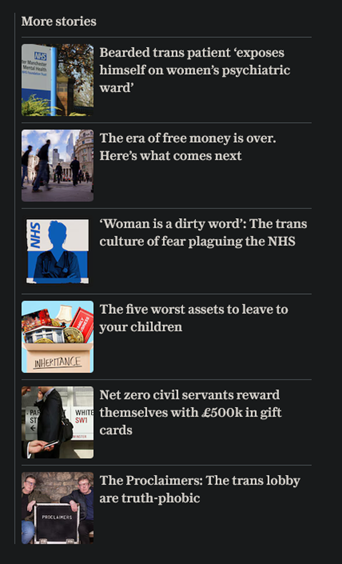
Case in point: on the 5th of September, which happens to be my birthday, someone named Poppy Coburn published an opinion piece on the website of The Telegraph, a UK newspaper. What type of newspaper is the Telegraph? One of those trashy tabloid rags that only low-class chavs read? Here’s a screenshot of the article sidebar, as it existed when I started writing this post:
And a sidebar I happened to see when I went to the home page for a screenshot of the paper’s logo:
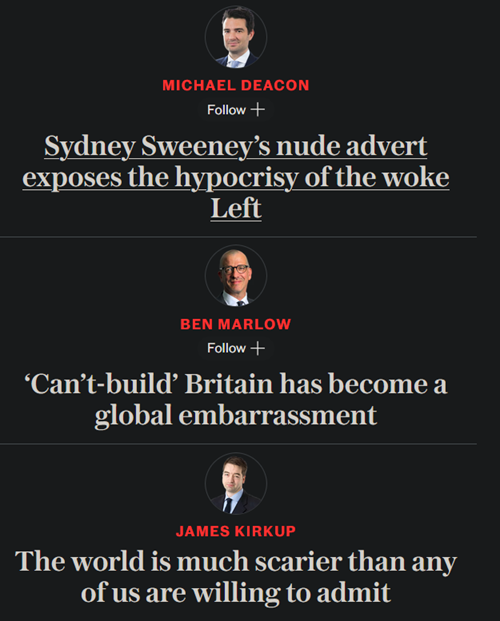
As you can see, the Telegraph is a stalwart bastion of old-school journalism and a respectable pillar of British society. And yet—somehow—Poppy Coburn’s article managed to sneak its way past the paper’s diligent editors. I guess it’s up to the bloggers to point out their mistake.
The article is called “How Having A Disability Became Cool”, and I feel like I could accurately reproduce its contents word for word based solely on that title, but I decided to show up the Telegraph editorial department by actually reading the thing. Here’s the subtitle:
“Young women, nicknamed ‘sickfluencers’, are turning chronic illness into a lifestyle trend and entrenching a culture of economic inactivity”
She kind of gives the game away at the end there, doesn’t she?
The gist of Coburn’s article is that people on disability benefits and/or who aren’t working due to disability or long-term illness are costing the UK too much money and are putting an unbearable strain on Britain’s public healthcare system and other social services. There’s been an explosion of disability claimants in the last few years—let’s say five or six years, just to pull a completely random number out of thin air—and it’s too much, the country can’t handle it, something needs to be done.
Now, not even the densent, basest, most craven-hearted, vacuous black hole of a human being (i.e. a conservative) would suggest that people on disability supports should simply be left to die. Even people lacking enough in self-respect to appear on GB News would hesitate before publicly proposing such a thing.
But what if a lot of these people on disability supports…aren’t actually disabled? What if they’re delusional, or faking it for attention? Poppy Coburn has seen a few disabled people on TV or, like, walking past her at the shops, and she reckons a lot of them are probably delusional or faking it, and she’s discovered the cause: “sickfluencers” on social media, who are making disability and chronic illness look trendy to young people.
…Just like how The Transes are transing your kids by transing it up in public.
“Perhaps you’ve seen it on a news segment on television about a transgender rights march, where every other attendee appears to be supported by a walking stick.”
I used to think people were exaggerating about how intensely transphobic the UK media is, but they’re not even trying to hide it, are they?
My central thesis in this post will be that Poppy Coburn’s argument is incoherent nonsense and was written to push a conservative social agenda, and I feel like I need to prove that this is so before we go any further. I’m not going to take the article apart line by line, so instead let’s just take some choice quotes from the first three paragraphs. Remember, the entire article is linked above if you want to make sure I’m not taking any of this out of context.
“Or perhaps you’ve heard about it in your family WhatsApp group, when your sister tells you about your seemingly healthy niece’s new condition.”
If your niece has been diagnosed with a medical condition, then by definition she isn’t healthy, “seemingly” or otherwise.
(I hope Coburn isn’t sub-tweeting a real person here and deciding she knows better than someone’s doctor).
“Whatever it is, the way you tell your story online can make all the difference.”
Is it? By what measure? Are there figures to back this claim up? Coburn links to outside sources elsewhere in the column, so why doesn’t she drop a link to a medical study here? It’s the crux of her entire argument, you’d think she’d want to convince people it was true before proceeding any further.
“Disability is changing. To many, it is no longer an adversity to overcome, but a social identity akin to one’s sexuality, gender, or race; an immutable reality to be celebrated by the subject and accommodated by the rest of us.”
A lot of people have accused Poppy Coburn of being ableist for writing this column, and they’ve accused the Telegraph of being ableist for publishing it. Based solely on the two sentences quoted above, those accusations are correct. In fact, you could use this as a case study on several of the ideological roots of ableism.
Let’s do that now:
1. Presenting disability as an “adversity to overcome” is decades out of date and is an attitude rejected by most disabled people today, for a host of reasons: it ignores the fact that many disabilities simply can’t be overcome, it frames those who are unable to “overcome” their disability as failures for not doing the impossible, and it feeds into the patronising attitudes that many disabled people face.
2. It’s deeply funny to me that Coburn thinks disability being a “social identity” is some kind of problem, given that the social model of disability has become the norm among academic study of the phenomenon and tends to be preferred by actual disabled people.
3. Yes, being disabled is an identity like sexuality, gender, or race. Or, to use identity labels that Coburn probably doesn’t mentally surround with sneer quotes, it’s an identity the same way that sex, class, or nationality are identities. It’s an aspect of who you are that changes how society perceives you and treats you. That’s what a social identity is.
4. When she complains about disability being considered “immutable”, with the implicit suggestion that this is incorrect, is she suggesting that she thinks sexuality, gender, and race are, or should be, mutable? I doubt it, especially in regards to gender, but this is why slamming out whatever shit comes into your head and then tossing it up in public is a bad idea: you end up making nonsensical arguments by accident.
5. What accommodations for disabled people does she object to? List them. Go into detail. I’d love to hear more about this.
No, Poppy Coburn, disability is not changing. This is always what disability has been. You, personally, have just been walking around with an image in your head of disabled people as sad war veterans on crutches, and like most conservatives, when confronted with the fact that the inside of your head doesn’t match reality, you decided that reality must be wrong.
“One in four British people is now disabled, according to the Department for Work and Pensions’ Family Resources Survey.”
How many of those people are old-age pensioners, who are allowed by people like Poppy Coburn to be “economically inactive”?
The Family Resources Survey—which Coburn doesn’t link to of course, she just takes it for granted that her readers will see this and clap like seals—doesn’t break down its disability statistics by age, but we can see that 45% of “state pension-aged adults” are classified as disabled. A little bit of maths and Googling puts that at 5,985,000 people. If one in four people in the total population are disabled, which the survey does indeed state, then the total disabled population of the UK is 17,500,000. In other words, elderly people make up 34% of the British disabled population. So mentally strike off a big chunk of the “one in four British people” Coburn is trying to scaremonger about, since they’re the good disableds and not the bad disableds.
Unlike the target readership of the Telegraph, you might at this point be wondering how the survey categorises someone as disabled. The survey’s methodology paper has some interesting information (emphasis mine):
The FRS does not record information on individuals in nursing or retirement homes, since it only surveys private households. This means that figures relating to people in older age groups may not be representative of the UK population, as some older people may have moved into homes where they can receive more frequent help. Therefore, it is likely that disability figures and impairments among all older people are higher than estimated from the FRS.
The way in which disabled people have been identified in the FRS has changed over time. […]
From the 2012 to 2013 survey year, a person is considered to have a disability if they regard themselves as having a long-standing illness, disability or impairment which causes substantial difficulty with day-to-day activities.
So a) the percentage of the disabled population who are old and therefore allowed to be disabled is definitely higher than my estimate and b) the way these surveys define people as disabled has changed. Previously, the methodology was based on questions about “barriers across several areas of life”, whereas looking at a copy of the most recent questionnaire it seems to be a lot more of a binary (the relevant question is on page 136). I’m not familiar with exactly how these questions were weighted, but it seems to me that asking someone what amounts to “are you disabled y/n” is going to capture much more of the disabled population than assessing barriers across nine different areas of functioning and then adding that together into an overall score.
Now, if I wanted to be really sneaky and dishonest—like if I wanted to get an opinion column published in a prestigious UK broadsheet newspaper—I could try to claim that this change in definition accounts for the rise in disabled people that Coburn is so worried about. But that wouldn’t be valid, because the questionnaire was changed in the year spanning 2012-2013 and the statistics showing the rise in disability are comparing 2014-2015 to 2024-2025, so the expanded definition would have already been in place.
But I do think it’s relevant, and to explain why let’s talk about something I noticed in the Family Resources Survey regarding disabled children. This is particularly interesting, since Coburn’s article is so concerned about the rising number of disabled young people. According to the section “Impairment types reported by disabled people by age group”, the two largest categories of disability in children are “social/behavioural” and “learning”.
You know what happened in the decade from 2015 to 2025? Diagnostic criteria for conditions like Autism Spectrum Disorder and ADHD changed, coupled with greater awareness of these conditions’ existence, particularly towards the less severe end of the scale. A lot of young people who might have either gone undiagnosed, or who were labelled as having generic “learning difficulties”, were now diagnosed with—and became personally aware of—these named, lifelong conditions.
Remember, the survey Coburn is getting her scary “one in four” statistic from considers a person to be disabled if “they regard themselves as having a long-standing illness, disability or impairment which causes substantial difficulty with day-to-day activities.” If, over that ten-year span, a lot of young people were diagnosed with things like ASD or ADHD due to expanded diagnostic criteria, and the definition of “disability” was made broader and more generalised, that could account for a lot of the three-million person increase in disability captured in the survey.
I know Coburn is aware of the expanded diagnostic criteria, because she complains about it later in her article, so how did it not occur to her that this, and not the insidious influence of Instagram posters, might explain the growing number of disabled young people? Did she just not put the two thoughts together at any point?
This is, in my opinion, the most substantive factual criticism of Coburn’s article, and it comes in response to a claim she makes at the beginning of the third paragraph. I could just stop here, but it turns out the article isn’t terribly focused and makes a bunch of other bullshit claims about disability, which I will now address more succinctly.
Here is Coburn attempting to explain her issue with “sickfluencers”:
“A cohort of young people – somewhat cruelly dubbed “sickfluencers” – want to tell you about their conditions and convince you they are real. Like the rest of my generation, they broadcast their struggles to an online community of like-minded individuals. But, were they not decked out in the accessories of their disease, it would be impossible to perceive the conditions they consider to be so central to their interaction with the world.”
The issue with responding to Coburn’s arguments is that she often seems reluctant to state them plainly. The above paragraph is clearly implying that the sickfluencers are faking their conditions, but it doesn’t say that directly, so in the written text we’re left with Coburn snarking about… illnesses not being visible to the naked eye, I guess?
This is kind of worrying for people in her orbit, honestly. I imagine a friend or colleague reluctantly pulling her aside to tell her they’ve just been diagnosed with cancer, only for her to reply with, “Well you don’t look like you have cancer. Show me the tumour.”
The entire column is permeated with this same roundabout manner, where it gestures in the vague direction of a point while maintaining a veneer of plausible deniability. This can at times make it hard to understand what Coburn is even complaining about. Take, for example, the section about the chronic illness influencers who are supposed to be at the core of her argument: after several paragraphs where she accurately—even sympathetically—explains why they attract such a following, she then gestures limply at (unnamed) influencers who failed to disclose advertisements in their content, or who misrepresented themselves as medical professionals. Okay, yes, those things are bad, but they’re also endemic to the entire influencer landscape. Where is the issue with the “sickfluencers”, specifically? What is the actual problem here?
Well, the article does sort of lay that out when it clumsily segues onto the topic of POTS, or Positional Orthostatic Tachycardia Syndrome, a condition that can cause (among other things) rapid heart-rate fluctuations when standing or moving. POTS is one of Coburn’s case studies for how this influencer-induced fake illness phenomenon is supposed to work, and it’s a very good case study, in that it reveals that she either doesn’t know what she’s talking about, or is lying.
“The condition manifests through palpitations, dizziness, and a rapid increase in heart rate upon standing (with the arbitrary medical benchmark for diagnosis placed at 30 beats-per-minute faster compared to sitting).”
Coburn misrepresents both the criteria and methodology for diagnosing POTS in order to make them seem more likely to produce false positives. I’m actually surprised she chose POTS to single out as an example, because in my opinion it’s one of the easier “invisible” conditions to diagnose or rule out: there’s a standardized test for it, how someone’s heart rate responds to that test determines whether they have POTS or not. It’s not a good example of the hazy, subjective grey area that the rest of the column is trying to make chronic illnesses out to be. But then, I guess Coburn can just get around this by making shit up.
Quoting the author of The Age of Diagnosis (a book that Amazon really wants me to buy for some reason, going by how often it comes up in my recommendations), the column makes this particularly weaselly argument:
“But, says O’Sullivan, there is no “demonstrable pathology or proof of a nervous system disorder. There is no pathology to prove a diagnosis””
No, there isn’t currently “proof of a nervous system disorder” in POTS patients, but there is a set of diagnostic criteria based on symptomology. This is like claiming you can’t diagnose someone with diabetes unless you root around in their pancreas first. What do Suzanne O’Sullivan and Poppy Coburn think is going on with diagnosed POTS patients? Are they manipulating their heart rates on purpose?
“Some women, however, do not accept such a verdict. Invariably, these individuals have already decided they have a certain condition before they see a doctor, and if the GP refuses to validate their beliefs, they “seek out a private specialist and get a diagnosis of an unusual condition,” says Musgrave.”
I actually know someone who has POTS, along with several other “trendy” conditions that Coburn takes aim at. She was diagnosed at the age of 29 after a long and tortuous journey that resembles the pattern Coburn outlines here: she had a general suspicion of what was wrong with her, was told it was all in her head by a conga line of doctors, and eventually went to a private specialist who diagnosed her. But the reason she rejected the previous doctors isn’t because they wouldn’t “validate her beliefs”, it was because they were wrong. The things they told her to do to alleviate her debilitating symptoms didn’t work; the treatments her specialist has given her, meanwhile, have made a meaningful improvement to many of those symptoms.
“Seeking out a private specialist” is framed here as someone paying for a diagnosis, as though consultants just slap medical labels on people because they ask nicely and pay the consulting fee. If Coburn or any of the people she quotes in this piece have evidence of this widespread medical malpractice, it’s very odd that they don’t present it.
The reason people go to specialists is because general practitioners often don’t know anything about rare conditions. This is something I actually experienced firsthand; I’ve avoided talking about my own experience with chronic illness up until now, lest Poppy Coburn accuse me of engaging in Identity, but I feel it’s too good an illustration to pass up.
Back in 2016, I was in a car accident that resulted in worsening neurological conditions, including constant dizziness, loss of balance, headaches, and a bunch of other shit I won’t get into. I went to doctors; they told me it was post-concussion and would get better in six weeks. It didn’t. I went to more doctors; they told me it was an inner ear problem and would get better in six months. It didn’t. I went to more doctors and specialists, all of whom commented in mystified tones about how weird and strange my symptoms were and how odd it was that I wasn’t getting better. Several of them clearly thought I was faking it.
Eventually—it took my GP over a year to make the referral—I ended up in front of a neurologist at a fancy private hospital. Nice guy, long career, couldn’t be more qualified, just the man you’d go to about a brain tumour or Parkinson’s. He prescribed me some medications that didn’t work, then commented in mystified tones about how weird and strange my symptoms were and how odd it was that I wasn’t getting better. After eighteen months of this, out of ideas and obviously disheartened with his inability to help me, he decided as one last hail mary to refer me to his colleague, a headache specialist, just in case I could be experiencing some sort of migraine condition. His tone of voice indicated that this wasn’t likely to help, and that I shouldn’t get my hopes up.
That headache specialist talked to me for about fifteen minutes, then diagnosed me with a form of treatment-resistant chronic migraine that’s often triggered by physical impacts. He estimated that over the span of his career, he had seen hundreds of patients just like me. Not only was my condition not strange and mystifying, it was well known to the small sub-set of neurologists specialising in migraine treatment.
This specialist also worked in the same office suite as the neurologist who had been so baffled by my symptoms, literally right next door. The two of them must have seen each other dozens of times a day. During a later appointment, he told me that general neurologists only get a single lecture on migraine during their training.
The point I’m making here is that people with rare or difficult-to-treat conditions seek out private experts because those experts know what they’re talking about. If Coburn’s approved GPs would prefer to tell their patients that it’s all in their head then more power to them, but they shouldn’t be surprised when those patients look elsewhere for answers.
Anyway, Coburn spends a lot of time explaining the psychological mechanisms of the “social contagion” model of chronic illness, but since she has not in any way evidenced that such a thing is happening, I don’t feel like bothering to discuss it. She spends some time griping that the diagnostic criteria for autism has been widened too far, during which she says this:
“The profile of what the medical establishment considers to be a typical autistic person has changed, from young males displaying obvious and debilitating symptoms from early childhood to adults and increasingly females.”
This is a particularly odd feature of the column: repeatedly, Coburn brings up the fact that the demographics of certain conditions have shifted to include more women and girls, with the implication that this is suspicious or strange, or is some kind of problem. I’m not sure what exactly she’s trying to get at here, but it comes across as a little bit misogynistic. So what if more women are getting diagnosed with autism? Is autism a sacred boys-only club or something?
After this she veers towards reality when discussing comorbidities, before making a sharp left turn back into fantasy-land at the last second:
“There is a wealth of medical evidence that disorders with no proven pathology overlap. In many of these cases, if the cause is medical, it is strictly psychosomatic.”
Based on…? How do you know this? What is your evidence? Can we please see your data, Dr. Coburn?
The actual reason why many conditions are comorbid is because they have the same underlying cause, or are at least suspected to—this is an area of ongoing research with a lot of new discoveries coming out every year. If the Poppy Coburns of the world had their way, that research would stop immediately, because after all, she’s used her medical degree to figure out that all of the comorbidies are purely psychosomatic.
“But how does the family of a non-verbal autistic child, who must be constantly monitored lest they begin banging their head against any available hard surface, respond to the definition of autism now apparently applying to a young woman who seems to excel at social interactions but feels fatigued after spending too much time around her friends?”
This is another one of those “what is the actual problem here” cases I mentioned earlier. So this hypothetical family has a severely autistic child who needs a lot of care and input, and there’s this other hypothetical autistic child who doesn’t need that level of care and input, and……..what? Are resources being taken away from the first child and given to the second one? Is the first family going to lose their carer’s allowance? Again, what is the actual problem here, Poppy Coburn? What are you complaining about? Or are you just mad that the image of autism you’ve been carrying around in your head is wrong?
Ah, but she does identify one practical impact: waiting lists.
“How do they feel when their child must wait for months to see a specialist doctor thanks to a waiting list now clogged with people suffering from mild social anxiety?”
First off, adults seeing someone for mild social anxiety wouldn’t be anywhere near the same waiting list as a severely autistic child, so Coburn is just making up a problem that doesn’t exist here. But secondly, if there’s an issue with waiting lists then that could be solved by greatly increasing public services funding, something I’m sure Poppy Coburn’s preferred brand of conservative government will get to right away once they’re in power.
The final section of the article, titled “the cost to the economy”, is where Coburn tries to explain why her readers should actually care about any of this shit in practical terms, and tellingly it’s by far the shortest section. Coburn makes a lot of factual, numerical claims here that she provides absolutely no source for, which means fact-checking her is difficult.
…Well, no actually, it’s extremely easy. For example, she doesn’t provide a source for her claim that one in ten working-age British people are now on disability or illness benefits, but a quick google search of that phrase brings up a number of places where the statistic could have come from, such as this BBC article, which shows that the rise in working-aged disability/illness claimants between 2019 and 2025 was about one million. Don’t feel too bad for those people though: a huge percentage of them are getting benefits for things like ADHD, which according to Poppy Coburn isn’t a big deal. Why, the percentage of benefit claimants citing “mental and behavioural” conditions has surged and exploded by…five percent.
Doesn’t sound so scary when you actually cite numbers, does it? Much better to just talk vaguely about how costs and numbers are soaring upwards.
While I was “researching” these numbers (ie doing a ten-second google search) I came across this article, which makes the following interesting claim:
“Today, figures obtained by The Lead from the Department for Work and Pensions (DWP) under the Freedom of Information Act show that between January 2024 and November 2025, 36 percent – more than a third – of all new claimants of the Universal Credit health element were aged 50 or over.”
I can’t verify this, because it’s based on data that this publication apparently obtained themselves and isn’t, to my knowledge, available publicly yet, but that sure would put Coburn’s scaremongering about sick young people into perspective.
Next, Coburn’s column moves onto school accommodations, and accidentally makes a very revealing point:
“And it’s not just immediate welfare costs that are placing a strain on public finances. The number of school children receiving SEN (Special Educational Needs) support has soared since the pandemic”
The pandemic, you say? And that BBC article she’s maybe-subtweeting measured a rise in disability claims since 2019. I wonder if anything happened just after 2019 that could help to explain this mystifying rise in people struggling with long-term illnesses?
After this, Coburn takes one last swipe at trans people (of course) and then wraps up with some nonsensical waffle about encouraging a “recovery identity” in sick people.
So, what do I make of all of this?
This probably goes without saying by now, but I don’t find Poppy Coburn’s argument—insofar as she makes one at all—convincing. She is clearly speaking from a place of profound ignorance regarding the topics she’s chosen to opine on, she asserts a range of facts to be true without providing a single piece of evidence to back them up, and on the few occasions where she does cite numbers, they’re the kinds of surface-level statistics that are vomited up by a Google AI summary. If Coburn did more than five minutes of research for this column, it’s not evident in the column itself.
Based on the things she says and how much importance she gives different topics, I am skeptical that Coburn’s primary concern is national health or the economy. Rather, I think she’s primarily just aggrieved to find that her mental image of disability no longer aligns with reality, just as conservatives are aggrieved that their mental image of gender no longer aligns with the reality of trans and non-binary people. Poppy Coburn doesn’t like these new-fangled hipster cripples with their colourful walking sticks and social media accounts and acronyms; she thinks they’re whiny and cringe compared to the quietly-suffering legless soldiers who fit her existing image of disability. She especially doesn’t like it when they’re young, and she especially especially doesn’t like it when they’re young and female. I’m not going to try and guess what’s going on there, but it seems like she might have some baggage when it comes to younger women.
The thing is, I don’t disagree with Coburn on the existence of the individual components of her claim.
Do some people fake illnesses, either deliberately or unknowingly? Yes, they do, we used to call it Munchausen’s but now refer to it as factitious disorder, and it’s well-documented in medical literature.
Have there been social media “sickfluencers” who have been found to be faking or exaggerating their conditions? Yes, there have been.
Is it possible that someone could see one of these influencers and, for whatever reason, be nudged into believing they have a condition that they don’t? Sure, that could happen. Nothing about the scenario seems inherently implausible.
But my response to that would be: so fucking what? This isn’t actually a problem unless it’s happening at scale, and not only does Coburn not prove that it’s happening at scale, she doesn’t even attempt to do so. She just asserts that it is happening, then trusts her readers to make the necessary logical jumps to arrive at her desired end point: if it’s happening at all then it must be happening a lot, and if it’s happening a lot then it must be a big problem, and since it’s such a big problem, we need to kick millions of people off of disability support based on vibes.
Doing this will kill people. That’s not me engaging in Telegraph-style fearmongering: it’s already happened. Poppy Coburn, the Telegraph editors, and everyone else who supports this viewpoint want to take actions that will kill disabled people, all to alleviate a non-issue whose existence they haven’t even proven.
Now I have to speak to the people who are taken in by this bullshit. Judging by the comments section under the article, there aren’t that many of you, but even a few is too many. So, my neighbours across the Irish Sea, my home slices, my absolute blokes, I have to ask: do you remember Brexit?
You know, when a bunch of conservative shitheads said that voting for Brexit would free up eleven trillion pounds or whatever for the NHS, and then you voted for Brexit, and then that didn’t fucking happen and Nigel Farage admitted that he was lying? Yeah, that’s happening again now. Conservatives are once again trying to get into power by pointing to a designated enemy that’s supposedly draining money from the public bank account, and if you’re stupid enough to fall for it again, you will again get burned.
I need you, hypothetical future Reform voter, to understand this, so I’m going to emphasise it: killing disabled people isn’t going to increase NHS funding, because the politicians trying to get your permission to kill disabled people do not want to fund the NHS. They would, in fact, be quite happy if the NHS went bankrupt and got sold to Elon Musk. They don’t think the government has any obligation to provide services to its citizens. Their ideal healthcare strategy is to tell you to go fuck yourself.
People like Poppy Coburn and the politicians she supports are matadors, waving a succession of minorities and state-approved enemies in your face so you don’t notice the blade in their other hand. They did it with Muslims, gay people, immigrants, the EU, refugees, and trans people, and now they’re trying it with disabled and chronically ill people. It’s the same grift every time: These People are causing all of our country’s problems, vote for us and we’ll do something about it, and everything will go back to the way it was in the good old days.
No political body making this promise has ever kept it. They never intended to. They’re think you’re a gullible rube for believing in it. Do you really want to prove them right?
(Postscript: The Telegraph put out a response to the backlash against the article that basically said “we put this on our website because we have no journalistic standards.” Didn’t need to tell me that, but thanks for saying it out loud).